 Welcome to ANCI Website!
 Certificate query
 Follow WeChat
 Anci Weibo
 Sitemap
 中文
中文
anciContact Us
Service Hotline
net01@gtggroup.com
Mobile: 18826804895
FAX: 0769-85075898
E-mail: net01@gtggroup.com
Address: No. 11, headquarters 2 Road, Songshanhu high tech Industrial Development Zone, Dongguan City, Guangdong Province
PC Power Supply FCC Certification EMC Testing and Compliance Guide
Edit: ANCI 2026-07-03 293
FCC certification for PC power supplies — including ATX, SFX, and TFX form factors — is a mandatory EMC compliance requirement for the US market. Under FCC Part 15 Subpart B, PC power supplies are classified as unintentional radiators and must demonstrate compliance with conducted and radiated emission limits through the Supplier's Declaration of Conformity procedure. Modern PC PSUs featuring 80 PLUS Titanium efficiency ratings, digital power management interfaces, and multi-rail output architectures present distinct EMC challenges. This article examines the FCC Part 15B testing framework for PC power supplies, covering device classification, multi-rail load configuration, conducted and radiated emission measurement methodology, and strategies for integrating FCC testing with international EMC certification requirements for manufacturers serving the global PC component market.
FCC Part 15B Framework and Classification for PC Power Supplies
FCC Part 15 Subpart B (Sections 15.107 and 15.109) establishes the emission limits for unintentional radiators, with Class A for commercial/industrial environments and Class B for residential use. PC power supplies sold through retail and e-commerce channels for consumer desktop PC building are Class B devices, subject to the more stringent limits — approximately 10 dB tighter than Class A across conducted and radiated emission measurements. PC PSUs marketed exclusively for server, workstation, or industrial PC applications may qualify for Class A. The classification decision determines the product labeling and user documentation requirements: Class B devices must include a specific FCC compliance statement in the user manual, while Class A devices carry a different statement reflecting their restricted-use classification.
The SDOC compliance path for PC PSUs requires testing at an FCC-recognized accredited laboratory, preparation of a compliance information statement, and product labeling. There is no FCC filing requirement or grant issuance — the responsible party maintains the test records and must produce them upon request. For PC PSU manufacturers, the SDOC path is administratively straightforward but places the full burden of compliance verification and documentation maintenance on the responsible party.
Conducted and Radiated Emission Measurement for Multi-Rail PC PSUs
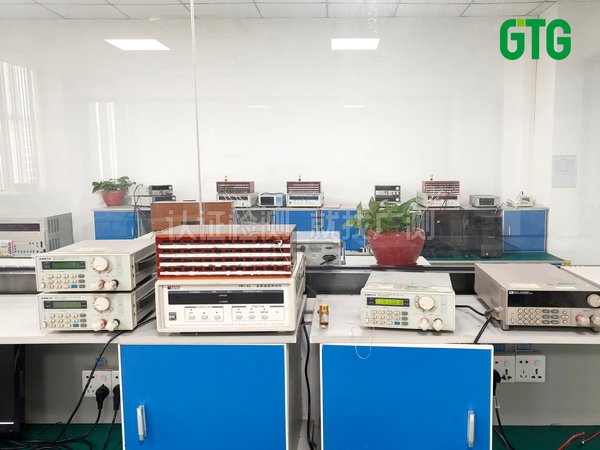
Conducted emission testing (150 kHz–30 MHz) for PC PSUs presents the challenge of multi-rail loading. A typical ATX PSU delivers +12V (single or multiple rails), +5V, +3.3V, -12V, and +5VSB outputs. The test load configuration must represent realistic PC operating conditions: the +12V rail typically carries 70-80% of total rated power, with the remaining distributed across +5V and +3.3V rails. The +5VSB rail must be loaded to its rated current as this standby circuit operates continuously even when the main outputs are in standby. Conducted emission measurements are performed using a Line Impedance Stabilization Network on the AC mains input, with quasi-peak and average detectors at each frequency from 150 kHz to 30 MHz.
Radiated emission testing (30 MHz–1 GHz, extending to higher frequencies if internal clock sources exceed 108 MHz) must be performed in a semi-anechoic chamber. The PC PSU is tested as a tabletop device connected to a representative resistive load bank. All modular output cables must be connected, and the cable management — routing, bundling, and termination — must be documented in the test report, as cable configuration significantly affects radiated emission results in the 30–300 MHz range. The dominant radiated emission sources in PC PSUs are the power switching devices and their associated heat sinks, the output cable harness, and ventilation openings in the enclosure. Pre-compliance scanning with PC PSU FCC pre-compliance EMC testing during the development phase identifies emission hot spots before formal certification, reducing the likelihood of failed tests requiring design iteration.
Key consideration: PC PSUs with semi-fanless operation modes — where the cooling fan stops at low loads — exhibit different radiated emission characteristics in fan-on and fan-off states. The fan's PWM control circuit and the change in thermal and grounding conditions when the fan stops can shift emission frequencies by several megahertz. FCC testing should evaluate both states, selecting the worst-case condition as the definitive measurement.
Frequently Asked Questions
Q1 Is an FCC ID required for a PC power supply sold as a standalone component?
No. A standalone PC PSU without wireless communication capability is an unintentional radiator under FCC Part 15 Subpart B and follows the SDOC procedure. No FCC ID is assigned, and no filing with the FCC is required. The manufacturer or importer must maintain the test report and compliance documentation. If the PSU incorporates a wireless module (such as Bluetooth for power monitoring), that module must obtain a separate FCC ID under Part 15 Subpart C.
Q2 How does the FCC test configuration account for modular cable PC PSUs?
All modular output connectors on the PSU must be populated with the supplied cables during testing. Each cable should be terminated with a representative load. The cable routing on the test table should follow typical PC installation practices — excess cable length may be loosely bundled but should not be tightly coiled, as coiling creates inductive effects that alter radiated emission characteristics. The test report must include photographs documenting the cable configuration for measurement reproducibility.
Q3 Can PC PSU FCC testing data support CE-EMC and UKCA compliance?
Yes. The EN 55032 (EU) and FCC Part 15B conducted and radiated emission measurements share the same frequency ranges and substantially overlapping measurement procedures per ANSI C63.4 and CISPR 32. A single chamber session configured to capture data for both standards can efficiently support FCC, CE, and UKCA compliance documentation. The primary difference lies in the limit values — Class A/B boundaries differ slightly between FCC and CISPR standards, requiring separate pass/fail assessment against each set of limits. PC PSU FCC and CE joint EMC testing from a single chamber campaign minimizes total certification time.
Q4 How should a PC PSU manufacturer handle FCC compliance across a product family with multiple wattage ratings?
A representative worst-case model should be selected for full testing. For a PSU platform family sharing the same PCB layout, topology, and EMI filter design across 550W, 650W, 750W, and 850W variants, the highest-power model typically represents the worst-case conducted and radiated emission scenario. Lower-power variants can be covered through engineering assessment, with the technical justification documented in the compliance file. If different members of the family use different EMI filter component values, each distinct filter configuration must be assessed for worst-case emission performance.
Q5 What design changes to a PC PSU trigger the need for FCC retesting?
Changes that typically warrant retesting include: modification of the EMI filter circuit topology or component values; changes to the main power switching semiconductors affecting switching frequency or dv/dt; PCB layout changes affecting the power stage, grounding scheme, or EMI filter section; addition or relocation of internal cabling that could affect radiated emissions; and enclosure design changes affecting ventilation opening patterns or internal shielding. A documented engineering change assessment process should trigger PC PSU FCC compliance impact review for each design revision to determine whether retesting is necessary.
This content is provided for industry communication and informational reference only and does not constitute any form of certification commitment, testing advice, or legal opinion. The certification requirements, procedures, and standards referenced herein may change as regulations evolve — please refer to the latest official announcements from the relevant authorities. Specific certification requirements, timelines, and costs must be evaluated by professional engineers based on the actual product. For inquiries, please contact us by phone.
Phone: +86 18826804895 | Email: net01@gtggroup.com | www.anci.com
Online Application
Global certification testing, please look for ANCI
Leave a message, certified engineers 1 to 1 technical guidance!
